

Collection: Paper Trays
Paper trays give incoming mail, active projects, bills, and finished documents a defined place on a desk or in a home office. Mind Reader's Paper Trays collection brings together 29 organizers so you can compare formats, tier counts, finishes, and stated fits in one place. Start with the kind of paper handling that suits your workspace, then open an individual product listing to review its dimensions, materials, pack count, and other listed details before ordering.

Choose a paper tray format
Horizontal paper trays keep documents in levels on a desktop. They can be useful when you want to place papers down flat and see several active groups at once. The collection includes single trays, two-tier and three-tier options, and taller organizers with four, five, six, or seven tiers. Stackable models can be arranged as a compact set or used as separate trays, depending on the product's stated design and pack size.
A vertical file holder keeps papers and folders standing upright rather than spread across horizontal shelves. This format can suit a desk where folders need to remain easy to pull out, or a workspace where upright storage fits the available depth better. Several products in this collection are listed as vertical file holders. Check each listing for its dimensions and stated fit instead of assuming that every tray accommodates the same paper size.
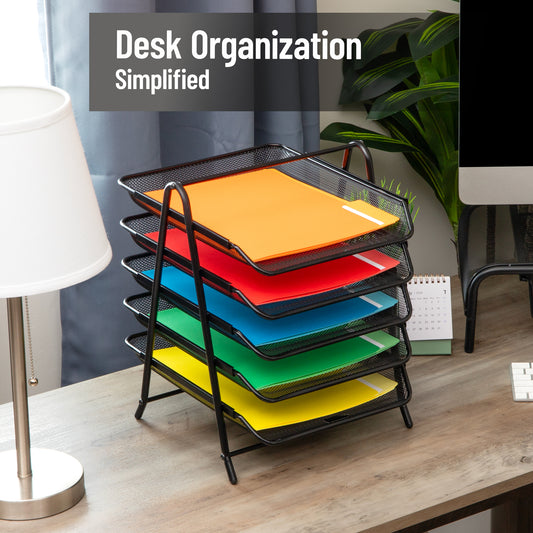
For a taller multi-level option, see the Mind Reader 6-Tier Paper Tray. It is listed as a six-tier, metal-mesh desktop organizer for office file storage. The collection also includes products listed for letter-size documents, so compare the individual product description when letter-size fit is important to your setup.
Match the tier count to your sorting routine
Tier count is a simple way to narrow the collection. A two-tier tray can separate two active groups, such as incoming papers and documents ready to file. Three- and four-tier formats can give separate levels to more categories without requiring a tall organizer. Five-, six-, and seven-tier designs provide additional levels for people who sort by project, destination, priority, or stage of work. The right number depends on how many groups you want visible and how much vertical space is available above the desk.
Use the product titles, dimensions, and descriptions as the final check. Some products are sold as sets, while others are single organizers. Some listings identify removable shelves, a top supply compartment, or a vertical file-holder format. Those details can change how a product fits into your routine, so review the exact product page rather than choosing from tier count alone.
Compare materials and finishes
The Paper Trays collection includes metal mesh, acrylic, bamboo, rattan, PU leather, plastic, metal, and metal-and-wood options. Metal-mesh trays provide an open, structured look for a desk or office. Acrylic and bamboo trays offer different surface finishes for a home workspace or coordinated desk arrangement. Rattan and PU leather options bring another visual texture, while metal-and-wood designs combine the listed materials in one organizer.

Choose a finish based on the surrounding desk accessories and the product details that matter most to you. If you want a clear organizer, review the acrylic listings. If you prefer a natural-looking surface, compare the bamboo or rattan options. If you need an open mesh style, use the metal-mesh listings as your starting point. Product images show the listed finish, but the product page remains the best source for dimensions, materials, care information, and stated fit.

Build a paper-sorting setup for your desk
Begin by listing the paper groups you handle most often. You might separate mail, bills, active work, documents waiting for a response, and papers ready for filing. Then compare the number of tiers, the horizontal or vertical format, and the product dimensions with the space available on your desk. A stackable set can help you compare several levels in one arrangement, while a vertical holder can keep folders upright when that is the preferred orientation.
Paper trays can also be part of a broader desk-organization setup. Use the product listing to confirm whether an organizer includes multiple pieces, a supply compartment, or another stated feature. To browse additional paper and file organizers beyond this focused collection, visit Desk Organization. For every item, confirm the listed size and materials before ordering, especially when the tray will sit beneath a shelf, beside a monitor, or next to other accessories.
Paper tray FAQ
What can I store in a paper tray?
Paper trays can organize documents, incoming mail, bills, folders, and other papers that match the product's stated size and capacity. Review the individual listing for the exact dimensions, fit, and any stated limits before placing an item in the tray.
Should I choose a stackable or vertical paper tray?
Choose a stackable or horizontal tray when you want papers arranged in levels on a desktop. Choose a vertical file holder when you prefer folders or papers to stand upright. Compare the product dimensions with your available desk space and check the listing's stated format.
Are these paper trays letter-size?
Several products in this collection are listed for letter-size documents, but the collection includes different formats and dimensions. Open the product page for the exact item you are considering and confirm its stated fit before ordering.
How do I choose the number of tiers?
Match the tier count to the number of paper groups you want to keep separate and the vertical space available on your desk. Two tiers can separate a couple of active groups, while taller five-, six-, or seven-tier organizers provide more levels in one footprint. Confirm the product's dimensions and construction on its listing.
-
Mind Reader Stackable Paper Tray, Desktop Organizer, File Storage, Office, Metal Mesh, 14"L x 9.75"W x 11.25"H, 4 Pcs.
Regular price $18.99 USDRegular priceUnit price per -
Mind Reader 3-Piece Acrylic Desktop Organizer Set, Frosted Clear Paper Tray, Accessory Tray, Pen and Supply Organizer, Modular Desk Organization System
Regular price $39.99 USDRegular priceUnit price per -
Mind Reader PU Leather Desk Organizer and Letter Tray Set, Stackable Paper Tray, Pen Cup and Card Holder, Brown
Regular price $59.99 USDRegular priceUnit price per -
Mind Reader Metal Letter Size Paper Tray, Desktop Document Organizer with Non-Slip Pads, Office Desk Accessory Tray, Metal
Regular price $19.99 USDRegular priceUnit price per -


Mind Reader Rattan Paper Tray with Iron Frame, Desktop Organizer, Holds Letter Size Documents, Brown
Regular price $14.99 USDRegular priceUnit price per -
Mind Reader 2-Tier Rustic Paper Tray Organizer with Metal Frame, Wood Base for Desk or Office, Stackable, Metal and Wood, Black
Regular price $39.99 USDRegular priceUnit price per -
Mind Reader 5 Tier Paper Tray Desktop Organizer, Removable Shelves, Cut-Out Handles, Tool-Free Assembly, Metal Mesh, Black
Regular price $29.99 USDRegular priceUnit price per -
Mind Reader Gold Desk Organizer Set, Includes Pen Cup, Catchall Tray, File Box & Paper Tray, 4-Piece Metal Desktop Accessory Kit
Regular price $19.99 USDRegular priceUnit price per -
Mind Reader 2 Tier Paper Tray with Top Supply Compartment, Desktop File Organizer, Metal Mesh, Pink
Regular price $27.99 USDRegular priceUnit price per -


Mind Reader 2 Tier Paper Tray with Top Supply Compartment, Desktop File Organizer, Metal Mesh, Black
Regular price $27.99 USDRegular priceUnit price per -

Mind Reader Paper Tray and File Folder Set, Desktop Organizer, Storage, Office, Metal Mesh, Black
Regular price $39.99 USDRegular priceUnit price per -
Mind Reader Gold Geometric Paper Tray, Modern Organizer for Documents, Folders, and Office Supplies, Durable and Stylish, Metal, 10"L x 12.25"W x 2"H, Gold
Regular price $19.99 USDRegular priceUnit price per -
Mind Reader Stackable Paper Tray, Desktop Organizer, File Storage, Office, Plastic, 13.75"L x 10"W x 10.75"H, 4 Pcs.
Regular price From $29.99 USDRegular priceUnit price per -
Mind Reader Desktop Organizer, Vertical File Holder, Paper Trays, Office, Plastic, 12.5"L x 11.75"W x 9.5"H, Beige
Regular price From $27.99 USDRegular priceUnit price per -
Mind Reader Paper Tray, Desktop Organizer, File Storage, Modern, Office, Bamboo, 10.25"L x 12.5"W x 2.25"H, Brown
Regular price $24.99 USDRegular priceUnit price per -
Mind Reader Paper Tray, Desktop Organizer, File Storage, Modern, Office, Acrylic, 10.25"L x 12.5"W x 2"H, Clear
Regular price $19.99 USDRegular priceUnit price per


